Behavioural Science for Change: Why Communication Alone Won't Make Change Stick
Every organisation wants change to stick.
Whether it's adopting AI, embedding new ways of working or encouraging managers to have better conversations, the goal is the same: move people from awareness to action.
Yet too often, change programmes are judged by the quality of the communications rather than the behaviours they create. We celebrate email open rates, intranet visits and attendance at town halls, but weeks later people are still doing what they've always done.
That's because awareness doesn't automatically lead to behaviour change.
Why behaviour matters
Most people don't resist change because they don't understand it. They struggle because change asks them to break habits, learn something new or prioritise one action over another in an already busy day.
Behavioural science helps us understand why people behave the way they do. By combining insights from psychology, neuroscience and behavioural economics, it provides practical tools for designing change that works with human behaviour rather than against it.
Instead of asking, "How do we communicate this?", behavioural science encourages us to ask a different question:
"What behaviour are we trying to change?"
Communication is only part of the answer
Communication remains essential, but it isn't the intervention—it's one part of it.
If a new process takes too long, if managers aren't confident, or if the old way of working is easier, no amount of beautifully written communications will solve the problem.
Successful change programmes identify the behaviours that matter, understand what's stopping people from adopting them and design practical interventions to make those behaviours easier, more attractive and more likely.
That's where proven frameworks such as COM-B and EAST become invaluable. They help practitioners diagnose the real barriers to change rather than simply producing more messages.
Making change stick in practice
Imagine you're introducing a new AI tool.
A traditional communication campaign might focus on explaining the benefits and encouraging people to use it.
A behaviourally informed approach goes further. It asks:
Do people have the capability and confidence to use it?
Is it easier than the current way of working?
Are leaders modelling the behaviour?
What prompts or reminders will help build new habits?
How will we measure behaviour rather than just engagement?
These questions move us beyond communication outputs towards meaningful organisational outcomes.
From theory to application
Understanding behavioural science is one thing. Applying it to a real organisational challenge is another.
That's why we've created Using Behavioural Science to Deliver Change that Sticks—a practical three-session online bootcamp for internal communication, HR, OD and change professionals.
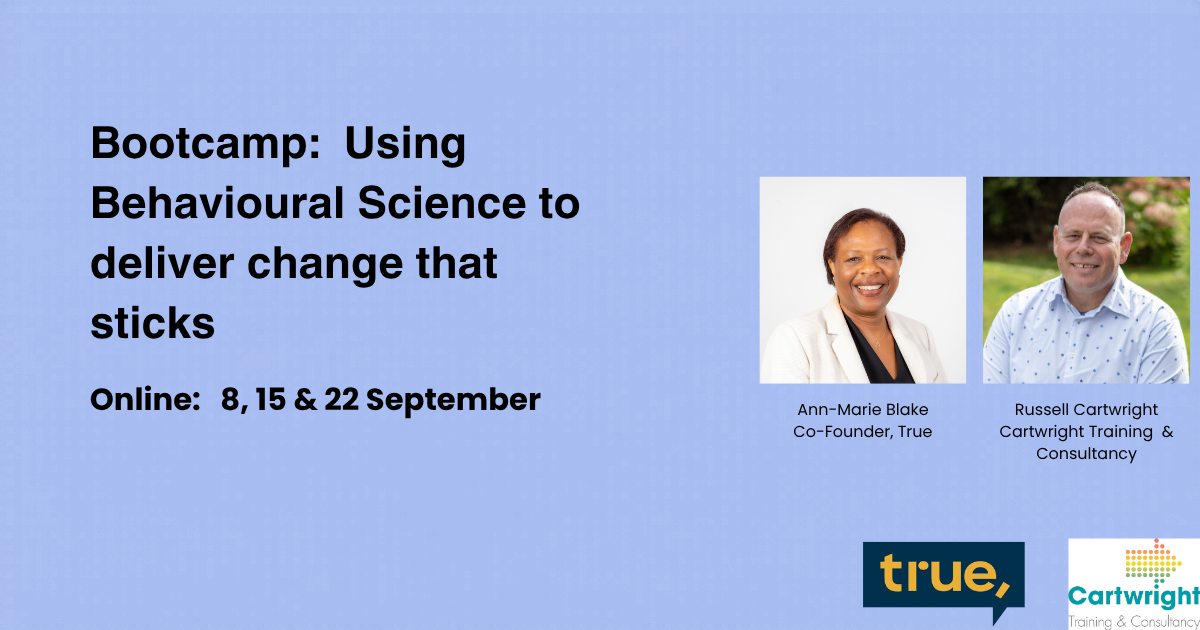
Behavioural Science to deliver change that sticks
Rather than simply learning the theory, participants bring a live organisational challenge and work through it using evidence-based frameworks. Across three interactive mornings, they'll learn how to define behavioural objectives, diagnose barriers using COM-B, design practical interventions with EAST, and build a behaviourally informed change plan ready to implement. The programme also explores how to test, measure and refine interventions so they deliver lasting results.
If you're tired of launching campaigns that generate awareness but fail to change behaviour, behavioural science offers a practical, evidence-based way forward.
Because successful change isn't measured by what people read.
It's measured by what people do.